Corporate Social Responsibility (CSR) has evolved beyond financial contributions and one-time charitable activities. Today, organisations are increasingly focused on creating measurable, sustainable, and meaningful social impact. Social Impact Assessment plays an important role in understanding whether CSR initiatives are addressing real community needs and creating meaningful outcomes. While funding, planning, and implementation are essential components of a CSR project, community participation in CSR projects is equally important for achieving long-term impact. By involving communities in the planning, implementation, monitoring, and evaluation of CSR initiatives, organisations can improve project relevance, strengthen community ownership, and ensure more sustainable outcomes.
Community participation means actively involving the people who are directly affected by a CSR initiative in the planning, implementation, monitoring, and evaluation of the project. When communities are given an opportunity to express their needs, contribute ideas, participate in decision-making, and take ownership of development activities, CSR projects are more likely to achieve sustainable outcomes.
For companies and implementing organisations, understanding the role of community participation can significantly improve the effectiveness and long-term impact of CSR initiatives.
What is Community Participation in CSR?
Community participation is a process through which local communities become active stakeholders in development and CSR projects, rather than being treated only as beneficiaries. As an important part of Social Impact Assessment, community participation enables organisations to understand local needs, involve stakeholders in decision-making, and ensure that CSR initiatives create meaningful, measurable, and sustainable social impact.
Instead of designing a project based solely on assumptions, organisations engage with community members to understand their actual needs, challenges, priorities, and expectations.
For example, a company may plan to implement a drinking water project in a rural community. Rather than simply installing water facilities, meaningful community participation would involve understanding:
- Existing water sources and accessibility
- Water-related challenges faced by households
- Community preferences regarding infrastructure
- Participation of women and vulnerable groups
- Local responsibilities for maintenance
- Community willingness to contribute to long-term management
This approach helps ensure that the intervention addresses a genuine need and is practical for the community.
Why is Community Participation Important for CSR Projects?
1. Helps Identify Real Community Needs
One of the biggest challenges in social development projects is the gap between what organisations assume communities need and what communities actually require.
Community consultation helps CSR teams understand local realities before designing an intervention.
For example, a livelihood project may initially focus on providing vocational training. However, discussions with community members may reveal that the major challenge is not training but access to markets, finance, transportation, or employment opportunities.
By understanding these issues at the beginning, CSR projects can be designed around actual community priorities.
2. Builds Ownership Among Beneficiaries
A project becomes more sustainable when communities feel that they are part of the process.
When people participate in identifying problems, developing solutions, and implementing activities, they are more likely to take ownership of the initiative.
For example, if a village participates in planning and managing a community sanitation initiative, residents may be more willing to maintain the facilities and encourage others to adopt better sanitation practices.
Community ownership can therefore transform a CSR project from a short-term intervention into a long-term community asset.
3. Improves Project Relevance
Every community has its own unique social, economic, cultural, and environmental characteristics, which are important considerations in Social Impact Assessment and CSR project planning. Understanding these local factors helps organisations design CSR projects that are relevant to community needs, inclusive, sustainable, and capable of creating meaningful social impact.
A solution that works in one location may not necessarily work in another. Community participation provides local knowledge that can help organisations adapt project activities to specific circumstances.
This can improve the relevance of interventions in areas such as:
- Education
- Healthcare
- Livelihood development
- Women empowerment
- Water and sanitation
- Skill development
- Rural development
- Environmental sustainability
4. Strengthens Trust Between Companies and Communities
CSR projects require trust between companies, implementing organisations, and communities.
When communities are consulted and their opinions are respected, they are more likely to develop confidence in the organisation implementing the project.
Transparent communication about project objectives, timelines, responsibilities, and expected outcomes can further strengthen this relationship.
Trust is particularly important when projects involve long-term behavioural or social change.
5. Improves Project Implementation
Community participation can also support smoother implementation.
Local community members often understand local conditions better than external project teams. Their knowledge can help identify potential challenges related to geography, culture, social relationships, local institutions, and accessibility.
Community members can also help with:
- Mobilisation
- Awareness creation
- Identification of beneficiaries
- Local coordination
- Communication
- Monitoring
- Maintenance of project assets
This local involvement can make implementation more efficient and responsive.
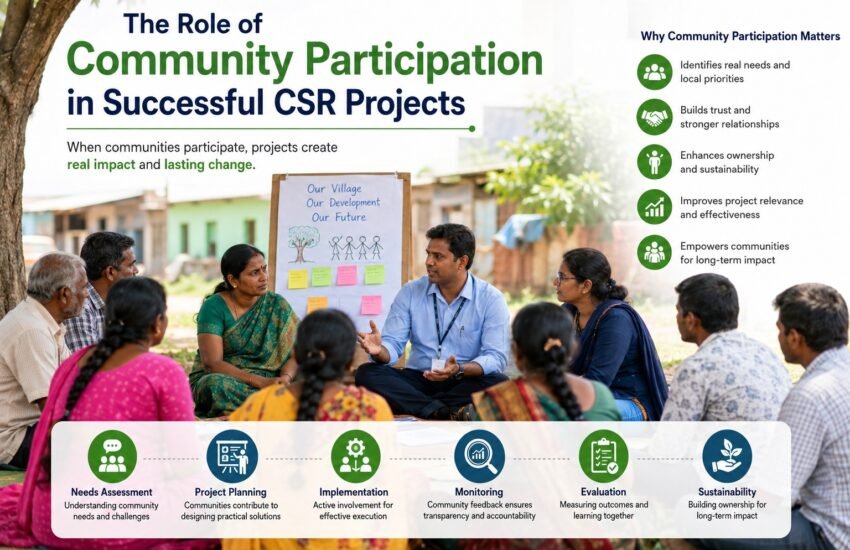
Community Participation Across the CSR Project Cycle
Community participation should not be limited to the initial stage of a project. It should be integrated throughout the entire project lifecycle.
1. Needs Assessment
The first step is understanding the community’s priorities.
Methods such as household surveys, focus group discussions, stakeholder consultations, interviews, community meetings, and participatory rural appraisal can help identify key needs and challenges.
The findings can then be used to establish a baseline for the project.
2. Project Planning
Once needs are identified, communities can participate in discussions about possible solutions.
Their feedback can help organisations determine whether proposed activities are practical, accessible, culturally appropriate, and sustainable.
3. Project Implementation
During implementation, community members can support mobilisation, awareness activities, training programmes, beneficiary engagement, and local coordination.
Their involvement can also help identify implementation challenges at an early stage.
4. Monitoring
Community members can contribute to monitoring by providing feedback about project performance and outcomes.
Participatory monitoring allows organisations to understand whether project activities are reaching the intended beneficiaries and whether the intervention is producing meaningful changes.
5. Evaluation
At the evaluation stage, community feedback provides an important perspective on project effectiveness.
An evaluation should not only ask whether planned activities were completed but also whether the intervention improved people’s lives.
Community perspectives can help assess changes in areas such as income, access to services, knowledge, behaviour, participation, and quality of life.
6. Sustainability
The ultimate objective of many CSR initiatives is to create benefits that continue after the formal project period ends.
Community participation is essential for achieving this.
When communities develop ownership, skills, leadership, and systems for maintaining project outcomes, the likelihood of long-term sustainability increases.
Inclusive Community Participation Matters
Community participation should be inclusive.
Simply conducting a community meeting does not necessarily mean that everyone has participated meaningfully.
Special attention should be given to groups that may have limited opportunities to express their views, including:
- Women
- Children and youth
- Persons with disabilities
- Economically disadvantaged households
- Marginalised communities
- Elderly people
- Other vulnerable groups
For example, in a water and sanitation project, women may have valuable insights because they often experience household water-related challenges differently. Similarly, young people may provide important perspectives on education, skills, employment, and technology.
Inclusive participation helps ensure that CSR projects do not unintentionally benefit only the most visible or influential groups within a community.
Role of Social Impact Assessment in Community Participation
Community participation and Social Impact Assessment (SIA) are closely connected.
A Social Impact Assessment helps organisations understand the social conditions, needs, outcomes, and changes associated with a project. Community engagement can provide valuable primary information for assessing these impacts.
Through structured consultations and data collection, organisations can understand:
- Existing community conditions
- Key development challenges
- Stakeholder expectations
- Positive and negative project impacts
- Changes resulting from the intervention
- Unintended outcomes
- Community perceptions
- Sustainability of project benefits
This evidence can help companies make better decisions and strengthen future CSR strategies.
Measuring the Impact of Community Participation
Community participation should also be evaluated.
Some useful indicators include:
- Number and diversity of community members engaged
- Participation of women and vulnerable groups
- Number of community consultations conducted
- Community satisfaction levels
- Number of community recommendations incorporated
- Level of community contribution
- Participation in project monitoring
- Community ownership of project activities
- Continuation of project activities after funding ends
Both quantitative and qualitative methods can be used to measure these outcomes.
Surveys can provide measurable data, while interviews and focus group discussions can provide deeper insights into community experiences and perceptions.
Common Challenges in Community Participation
Although community participation offers significant benefits, implementing it effectively can be challenging.
Limited Awareness
Communities may initially have limited understanding of the purpose of the CSR project or the importance of their participation.
Unequal Participation
Influential individuals or groups may dominate discussions, while vulnerable sections may remain unheard.
Language and Cultural Barriers
Communication challenges can affect the quality of engagement, particularly when external organisations work in communities with different languages or cultural practices.
Participation Fatigue
Repeated surveys, meetings, and consultations without visible action can reduce community interest and trust.
Unrealistic Expectations
Communities may sometimes expect benefits beyond the scope or budget of the CSR project.
These challenges can be addressed through transparent communication, inclusive engagement methods, appropriate facilitation, and continuous feedback mechanisms.
Best Practices for Effective Community Participation
For CSR projects to achieve meaningful community engagement, organisations should consider the following practices:
- Engage communities from the beginning rather than consulting them only after project decisions have been made.
- Listen before designing solutions. Understand community needs and priorities through systematic assessments.
- Ensure inclusive participation by creating opportunities for women, youth, vulnerable groups, and marginalised communities.
- Communicate clearly about project objectives, timelines, responsibilities, and limitations.
- Create feedback mechanisms so community members can share concerns and suggestions.
- Use local knowledge when designing project activities.
- Build local capacity so communities can manage and sustain project outcomes.
- Monitor participation, not just project activities and outputs.
- Measure outcomes and impact to understand whether community involvement is contributing to better results.
- Maintain engagement beyond project completion wherever long-term community ownership is required.
Conclusion
Community participation is not simply an additional activity within a CSR project. It is a fundamental approach to creating meaningful and sustainable social impact.
When communities participate in needs assessment, planning, implementation, monitoring, and evaluation, CSR projects are more likely to reflect real local priorities. Participation can strengthen trust, improve project relevance, increase ownership, and support long-term sustainability.
For companies and NGOs, the focus should therefore move from “projects for communities” to “projects with communities.”
A successful CSR initiative is not measured only by the amount invested or the number of activities completed. Its real value lies in the positive and sustainable changes created in people’s lives.
By combining community participation with systematic monitoring, evaluation, and Social Impact Assessment, organisations can move beyond measuring CSR expenditure and focus on what matters most: measurable, inclusive, and lasting social impact.
