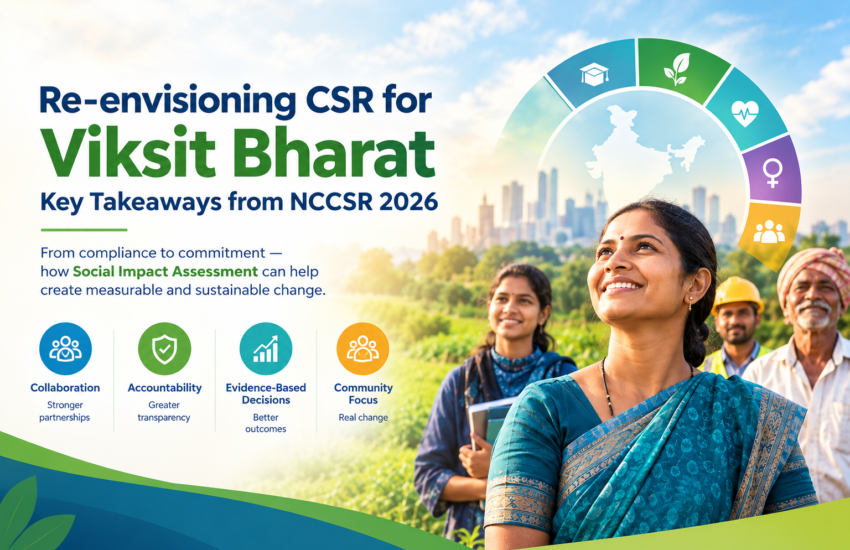
The 3rd National Conference and Exhibition on CSR (#NCCSR2026), organised by the School of Business Environment, Indian Institute of Corporate Affairs (IICA), under the Ministry of Corporate Affairs, was held in New Delhi on 6–7 October 2026. With the theme “Re-envisioning the Spirit of CSR for Viksit Bharat,” the conference highlighted how Social Impact Assessment can help companies move beyond CSR compliance towards measurable outcomes, greater accountability and sustainable social impact.
The discussions emphasised the need for stronger accountability, evidence-based decision-making, collaboration and meaningful outcomes from Corporate Social Responsibility (CSR) initiatives. The key takeaways from the conference are outlined below.
Moving Beyond Annual Compliance
Dr. Pallavi Jain Govil, Secretary, Ministry of Corporate Affairs, emphasised that CSR should be viewed as an integral part of India’s development journey rather than merely an annual corporate obligation. Strong Board oversight, transparent disclosures and systematic impact assessments are essential to achieving this objective.
Strengthening Corporate Ownership of CSR
Companies need to take greater responsibility for their CSR initiatives by aligning expenditure with identified community needs, clearly defined objectives and measurable outcomes. Effective monitoring and accountability mechanisms are equally important to ensure that CSR investments deliver meaningful benefits.
Encouraging Sector-Specific CSR Frameworks
The release of the Comprehensive CSR Framework for the Coal Sector highlighted the importance of sector-specific approaches to CSR implementation. The discussions also emphasised aligning CSR reporting with the Sustainable Development Goals (SDGs) to improve the relevance and effectiveness of interventions.
Enabling Collaboration through the CSR Exchange
The CSR Exchange can facilitate stronger partnerships by improving access to credible information on CSR projects and implementing agencies. Better data integration and coordination among stakeholders can help identify opportunities for collaboration, minimise duplication and improve resource utilisation.
Establishing Universal Impact Indicators
Consistent and comparable indicators are necessary to evaluate CSR initiatives across sectors and regions. However, these indicators should also reflect local priorities and be supported by district-level evidence to capture the specific needs and development challenges of communities.
Extending CSR to Underserved Regions
CSR initiatives need to reach underserved districts and communities where development needs remain significant. A more geographically inclusive approach can help ensure that the benefits of corporate social investment extend to communities that may otherwise receive limited support.
Leveraging Technology while Retaining Human Judgement
Technology and Artificial Intelligence (AI) can strengthen monitoring, reporting and accountability. However, as highlighted by Shri Ajit Seth, technology must complement rather than replace field-level understanding, administrative judgement and direct engagement with communities. Combining technological capabilities with on-ground evidence is essential for informed decision-making.
Linking Skill Development with Employment Opportunities
CSR programmes can create greater value by connecting skill development initiatives with actual employment opportunities. Linkages with initiatives such as the PM Internship Scheme can help bridge the gap between training and workforce participation, improving the relevance of skill development programmes.
Measuring Impact Beyond Expenditure
One of the key messages from the conference was that the success of CSR should be measured by the difference it makes to people’s lives, rather than simply by the amount spent.
This calls for a shift towards evidence-based planning, continuous monitoring and systematic assessment of social, economic and environmental outcomes. Reliable impact evidence can help companies understand what works, identify areas for improvement and make informed decisions about future CSR investments.
The focus, therefore, needs to move beyond financial expenditure and activity-based reporting towards understanding the actual changes experienced by beneficiaries and communities.
Where SIA for CSR Can Contribute
In line with the priorities discussed at NCCSR 2026, SIA for CSR (#SIAforCSR) supports companies in assessing the effectiveness of their CSR initiatives through independent, evidence-based Social Impact Assessment.
A joint programme of ITCOT and Strategy Partners Market Research & Consulting, SIA for CSR helps CSR teams strengthen decision-making, track implementation and evaluate outcomes throughout the project lifecycle.
Its key areas of support include:
Baseline Studies
Establishing initial conditions, identifying community needs and understanding existing challenges before a CSR project is designed or implemented. Baseline findings provide a reference point for measuring subsequent progress and assessing changes over time.
Monitoring and Evaluation
Tracking project implementation, assessing progress against defined objectives and identifying gaps that require corrective action. Regular monitoring helps CSR teams maintain accountability, improve programme delivery and ensure that activities remain aligned with intended outcomes.
Social Impact Assessment
Evaluating the social, economic and environmental outcomes of CSR initiatives to understand the changes experienced by beneficiaries and communities. Evidence-based assessments can help companies identify programme strengths, address implementation gaps and improve future CSR planning and resource allocation.
Sector-Wide Coverage
Supporting assessments across key CSR areas, including livelihoods, water and sanitation, public health, women’s Self-Help Groups (SHGs), gender inclusion, community development, education and environmental sustainability.
Through these services, SIA for CSR aims to help companies move beyond expenditure-based reporting towards a clearer understanding of programme effectiveness, beneficiary experiences and community-level outcomes.
From Compliance to Commitment: CSR for Viksit Bharat
The discussions at NCCSR 2026 reinforce the need for CSR to be guided by accountability, local relevance, collaboration and measurable impact. Achieving these objectives requires more than allocating funds; it calls for a structured approach to understanding community needs, tracking progress and evaluating the outcomes of interventions.
Independent Social Impact Assessment can support this process by providing credible evidence on whether CSR initiatives are addressing identified needs, reaching intended beneficiaries and contributing to sustainable change.
SIA for CSR aims to support Boards and CSR Heads in moving from compliance to commitment through credible evidence, independent assessment and outcome-focused decision-making.
By placing communities and measurable results at the centre of CSR, companies can strengthen the effectiveness of their initiatives, improve accountability and contribute to the broader vision of Viksit Bharat.
