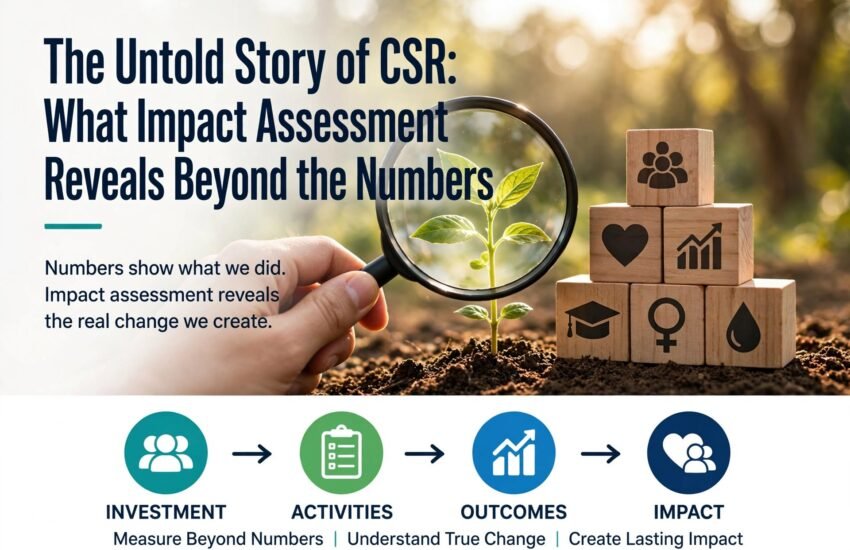
Corporate Social Responsibility (CSR) has evolved significantly over the years. What was once viewed primarily as a The Untold Story of CSR: What Social Impact Assessment Reveals Beyond the Numbers
How CSR Has Evolved
Corporate Social Responsibility (CSR) has changed a lot over the years. Earlier, many organisations saw CSR mainly as a form of giving back to society. Today, CSR plays a bigger role in business strategy, stakeholder engagement, and sustainable development. Organisations invest in education, healthcare, livelihoods, environmental protection, rural development, women’s empowerment, and skill development.
CSR reports often focus on money spent, projects completed, and beneficiaries reached. These numbers are useful, but they show only part of the picture. The bigger question is simple: What actually changed because of the CSR investment? This is where Social Impact Assessment (SIA) becomes important. It helps organisations understand whether their CSR projects create meaningful, measurable, and lasting change.
Moving Beyond CSR Numbers
A CSR project may look successful when we only look at numbers. For example, a skill development programme may train 500 young people. Out of them, 450 may complete the course and 300 may receive certificates. These figures show that the programme reached its targets. However, they do not tell us what happened after the training.
Social Impact Assessment looks deeper into these results. It asks whether participants found jobs or started businesses. It also checks whether their income increased and whether they continue to use their new skills. The assessment can also identify barriers such as transport problems, family responsibilities, migration, lack of finance, or limited local jobs. This changes the focus from “How many people did we reach?” to “What difference did we make?”
Understanding Activities, Outputs, Outcomes and Impact
A strong impact assessment separates activities, outputs, outcomes, and impact. An activity explains what the organisation did. For example, the organisation may conduct skill development training. An output shows what the project delivered, such as training 500 beneficiaries.
An outcome shows the change that follows the project. Participants may find jobs or start income-generating activities. Impact refers to the wider and longer-term change. This may include higher household income, better financial security, greater confidence, and improved quality of life. Many CSR programmes track activities and outputs well. However, Social Impact Assessment helps organisations understand the outcomes and long-term impact.
A Practical CSR Impact Example
Consider a CSR-funded livelihood programme for a rural community. The programme aims to improve employment opportunities for young people. It may provide vocational training, soft skills, career guidance, financial awareness, and job support.
During the programme, many participants attend training and receive certificates. The project report may show that the team achieved its targets. However, the organisation wants to know what happened after the training. So, it conducts a Social Impact Assessment to study the actual results.
The assessment first looks at the background of the beneficiaries. It considers their education, employment, household income, livelihood, and access to opportunities. It also looks at the challenges faced by women and economically vulnerable families. This helps the organisation understand the starting point of each group.
Following the Beneficiary Journey
The assessment then follows the beneficiary journey from training to real-life change. It checks whether participants found employment, started businesses, increased their income, or improved their financial position. Surveys provide useful numbers, while interviews and group discussions explain the reasons behind those results.
The findings may show that many beneficiaries moved into employment. Others may still face difficulties in finding stable work. Some may need better transport, more technical training, or financial support to start a business. Women may face mobility issues or family responsibilities. These findings do not mean the project failed. Instead, they show what worked and where the organisation can improve.
The Human Story Behind the Numbers
The most meaningful part of Social Impact Assessment is often the human story behind the numbers. A report may say that one beneficiary found a job after completing training. But the assessment asks what that job means for the person and their family.
The new income may help the family pay school fees or healthcare costs. It may also reduce the need for informal loans. The beneficiary may feel more confident about making financial decisions. One employment outcome can therefore create several positive changes. Skills can lead to employment, employment can increase income, and higher income can improve household security.
Why Beneficiary Voices Matter
Numbers can show that household income has increased. However, beneficiary interviews can explain what that increase means in daily life. A beneficiary may share how they now pay school fees, access healthcare, repay debt, or purchase productive assets.
These stories add meaning to the data. They help CSR teams understand the real value of their work. Listening to beneficiaries can also reveal unexpected outcomes. A livelihood project may improve employment while also increasing confidence and women’s participation in household decisions.
Learning From Challenges
A good Social Impact Assessment also looks at challenges. Not every beneficiary will experience the same level of change. Some projects may also face problems with beneficiary selection, implementation, market access, infrastructure, or community participation.
Finding these gaps does not mean CSR has failed. Instead, it gives organisations an opportunity to learn. They can improve project design, strengthen implementation, engage beneficiaries better, and use resources more effectively. This learning can make future CSR programmes stronger.
Measuring Long-Term Sustainability
Sustainability is another important part of impact assessment. A project may create positive results during the funding period. But organisations also need to know whether those benefits continue after the project ends.
For example, are trained beneficiaries still employed several months later? Is a community water facility still working and being maintained? Are women’s self-help groups still active? Have students improved their learning over time? These questions help organisations understand whether a project created short-term results or lasting impact.
Connecting CSR With Development Goals
Social Impact Assessment can also connect CSR projects with wider development priorities. Skill development can support employment and economic opportunity. Women’s empowerment can support gender equality. Education projects can improve learning outcomes, while healthcare projects can support better well-being.
Water and sanitation projects can also improve community health. By studying these connections, organisations can align CSR investments with broader development goals and the Sustainable Development Goals (SDGs). This approach can also help identify successful programmes that may need to be expanded.
Making Better CSR Decisions
Social Impact Assessment is not just a reporting or compliance activity. It can help organisations make better CSR decisions. CSR leaders can use the findings to decide which programmes should continue and which ones need improvement.
They can also identify successful models for scaling. In some cases, organisations may need to redirect resources to areas with greater need. This creates a stronger culture of accountability, learning, and evidence-based decision-making.
The Real Measure of CSR Impact
The untold story of CSR does not exist only in expenditure reports or beneficiary numbers. It exists in the changes experienced by people, families, and communities. Spending ₹1 crore, training 500 people, or reaching 1,000 beneficiaries are important achievements. But these numbers alone cannot define success.
Real success means creating better opportunities and stronger livelihoods. It also means helping communities become more resilient and improving people’s quality of life. Most importantly, the benefits should continue beyond the project period.
From Investment to Meaningful Change
Social Impact Assessment brings these stories to light. It connects investment with action, outputs with outcomes, and outcomes with meaningful social change. As businesses face greater expectations for responsibility and transparency, CSR must look beyond spending.
The important question is no longer only “How much did we spend?” It is also “How meaningfully did people’s lives change because of our investment?”
That is the true untold story of CSR. Social Impact Assessment helps organisations discover, measure, and strengthen that change.
