Looking Beyond Project Completion to Understand What Really Happened
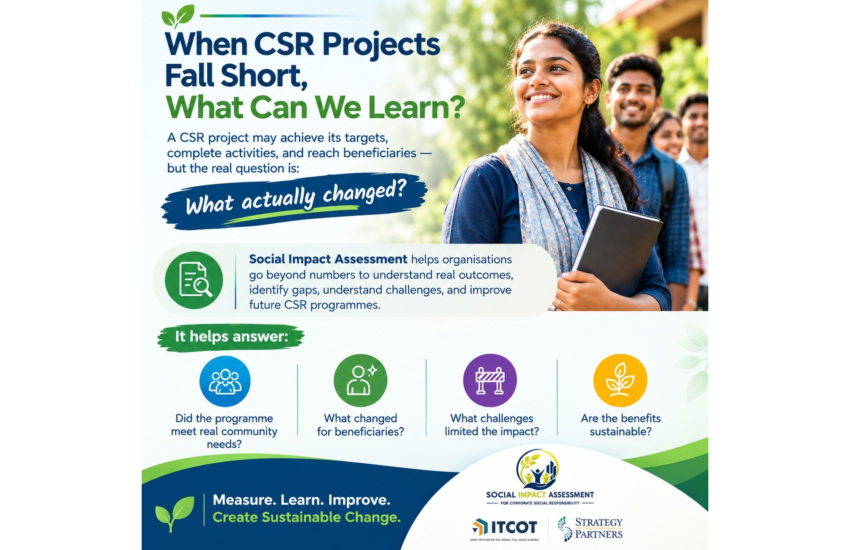
Corporate Social Responsibility (CSR) programmes are designed to create positive change. Organisations invest in education, healthcare, skill development, livelihoods, environmental conservation, community infrastructure, and other social development initiatives with clear objectives and expected outcomes. Considerable effort goes into planning, budgeting, implementation, monitoring, and reporting. Yet, even when a CSR project is completed successfully, the intended social outcomes may not always be achieved to the expected extent. A project may reach its beneficiary target, complete all planned activities, and utilise the allocated funds, but the actual change experienced by communities may be different from what was originally anticipated. This is where Social Impact Assessment (SIA) becomes valuable. It helps organisations look beyond project completion and understand what worked, what did not, why certain outcomes were achieved, and what can be improved.
A common challenge in CSR is the tendency to measure success through activities and outputs. For example, a skill development project may report that 1,000 young people were trained, 900 completed the programme, and 850 received certificates. An education programme may report the number of students reached, learning materials distributed, or schools supported. A healthcare programme may report the number of health camps conducted and patients screened. These figures are useful for understanding the scale of implementation, but they do not necessarily demonstrate social impact. The more important questions are: What changed for the beneficiaries? Did the intervention address their actual needs? Did the benefits continue after the project ended? What barriers limited the expected outcomes? Social Impact Assessment helps answer these questions through evidence gathered from beneficiaries, stakeholders, project records, and field-level observations.
Case Study: When a Skill Development Programme Did Not Deliver the Expected Outcome
Consider an illustrative CSR-funded skill development programme implemented for unemployed and underemployed youth in rural and semi-urban communities. The programme was designed to improve employability by providing vocational training, technical skills, communication skills, digital literacy, career guidance, and employment support. The project targeted young people from economically vulnerable households and aimed to connect trained participants with suitable employment or self-employment opportunities.
During the implementation period, the programme appeared to perform well. Beneficiaries were mobilised, training centres were established, sessions were conducted, assessments were completed, and certificates were issued. The project monitoring report showed that most of the planned training targets had been achieved. From an implementation perspective, the programme was progressing according to plan.
However, the CSR team wanted to understand what happened after the training. Did participants actually obtain employment? Were they able to use the skills they had acquired? Did their income improve? Were the courses relevant to local employment opportunities? What prevented some beneficiaries from progressing? These questions led to a Social Impact Assessment.
The assessment began with a review of the project design, objectives, beneficiary profile, training curriculum, monitoring data, and available baseline information. The assessment team then conducted primary research with beneficiaries and other stakeholders. Quantitative surveys helped measure employment status, income, training utilisation, and other relevant indicators. Qualitative interviews and focus group discussions provided insights into beneficiary experiences, challenges, and perceptions. Field visits helped the assessment team understand the local context, while discussions with trainers, employers, community representatives, and project personnel provided additional perspectives.
One of the first areas examined was beneficiary relevance. The assessment explored whether the programme had reached the intended target group and whether the courses offered were appropriate to beneficiary needs. It also considered educational qualifications, existing skills, employment aspirations, geographic location, and socio-economic circumstances. This revealed an important lesson: providing training does not automatically mean that the training is relevant to every beneficiary. Some participants may have selected courses because they were available, while others may have faced a mismatch between their interests and the occupations for which they were trained.
The next stage focused on the transition from training to employment. A certificate demonstrates that a beneficiary has completed a course, but it does not necessarily demonstrate employability or income generation. The assessment therefore examined whether participants had obtained jobs, started businesses, continued in employment, or remained unemployed after completing the programme. It also explored the reasons behind different outcomes.
For some beneficiaries, the training may have helped them obtain employment. For others, however, several barriers may have remained. These could include limited job opportunities in the local area, transportation challenges, family responsibilities, migration, lack of information about vacancies, inadequate practical exposure, or insufficient alignment between the training curriculum and employer requirements. For beneficiaries interested in entrepreneurship, lack of access to finance, market linkages, mentoring, or business support could also limit their ability to convert training into a sustainable livelihood.
These findings highlight an important distinction between outputs and outcomes. The number of people trained is an output. The number of people who secure and retain employment is an outcome. Increased income, improved household financial security, and sustained livelihood opportunities represent deeper changes that may emerge over time. A Social Impact Assessment helps organisations understand this entire chain rather than treating training completion as the final result.
Another important finding may emerge from beneficiary feedback. Participants may appreciate the training but identify areas where additional support is needed. For example, beneficiaries may indicate that practical training was insufficient, placement assistance was limited, or the curriculum needed to be more closely aligned with current market requirements. Employers may provide another perspective, identifying gaps in communication, digital capabilities, technical proficiency, or workplace readiness. Bringing these perspectives together allows CSR teams to understand the difference between what was planned, what was delivered, and what beneficiaries and employers actually needed.
The assessment can also reveal differences between beneficiary groups. Young women may experience mobility and family-related constraints that affect employment opportunities. Participants from remote locations may have fewer local employment options. Beneficiaries from economically disadvantaged households may not be able to relocate even when employment is available elsewhere. Such differences can remain hidden when project performance is reported only through overall beneficiary numbers. Disaggregated analysis can therefore provide a much clearer understanding of who benefited, who did not, and why.
Importantly, an assessment that identifies gaps should not automatically be interpreted as evidence that the entire CSR project was unsuccessful. Social development programmes operate within complex economic and social environments, and outcomes can be influenced by factors beyond the direct control of the implementing organisation. The value of SIA lies in identifying these factors and distinguishing between implementation gaps, design limitations, external constraints, and areas where additional support could improve outcomes.
For example, if the assessment finds that the training itself was effective but employment conversion was limited, the next phase could focus more strongly on employer partnerships, placement support, apprenticeships, and post-training follow-up. If transportation is a major barrier, training locations or mobility support could be reconsidered. If beneficiaries are interested in entrepreneurship but lack access to finance and markets, the programme could introduce enterprise development support. In this way, assessment findings become a foundation for programme improvement rather than simply a final evaluation.
Social Impact Assessment can also help organisations understand sustainability. A project may generate positive results during the period of CSR funding, but the longer-term question is whether those benefits continue after the intervention ends. In a skill development programme, for example, assessment may examine whether beneficiaries remain employed, whether their income remains stable, whether they continue using their acquired skills, and whether they have opportunities for further advancement. These indicators help organisations understand whether the intervention has created a lasting livelihood pathway or only a short-term benefit.
The broader lesson is that CSR success cannot be determined solely by whether a project was completed according to plan. Implementation success and social impact are related, but they are not the same. A project can achieve its activity targets while still requiring improvements in design, beneficiary engagement, market linkage, or sustainability. Conversely, a project may encounter implementation challenges but still generate meaningful outcomes for certain groups of beneficiaries. Only systematic assessment can help uncover these nuances.
This is why Social Impact Assessment should be viewed as a learning and decision-making tool rather than simply a reporting requirement. It enables organisations to understand beneficiary experiences, validate project outcomes, identify gaps, document unintended effects, assess sustainability, and generate practical recommendations. More importantly, it creates an evidence base for future CSR planning and resource allocation.
When a CSR project falls short of its intended outcomes, the most useful question is not simply “Did the project succeed or fail?” A more meaningful question is: “What does the evidence tell us about what happened, why it happened, and what can be done differently?”
That shift in perspective can transform CSR. Instead of viewing an assessment as a judgement at the end of a project, organisations can use it as a mechanism for continuous learning and improvement. The findings can inform the next programme cycle, strengthen implementation strategies, improve beneficiary targeting, refine indicators, and enhance the sustainability of social interventions.
Ultimately, the purpose of Social Impact Assessment is not to prove that every CSR project succeeded. Its purpose is to understand the reality of change. It brings together data, field evidence, stakeholder perspectives, and beneficiary experiences to reveal both achievements and gaps. When organisations are willing to examine what did not work alongside what did, they create opportunities to design more relevant, effective, and sustainable CSR programmes.
CSR impact is not defined by the completion of activities alone. It is understood through the changes that occur because of those activities. Social Impact Assessment helps organisations discover those changes, understand the reasons behind them, and use the learning to build stronger interventions for the future.
Measure. Learn. Improve. Create Sustainable Change.
That is how Social Impact Assessment can turn the lessons from projects that fall short into opportunities for better CSR.
