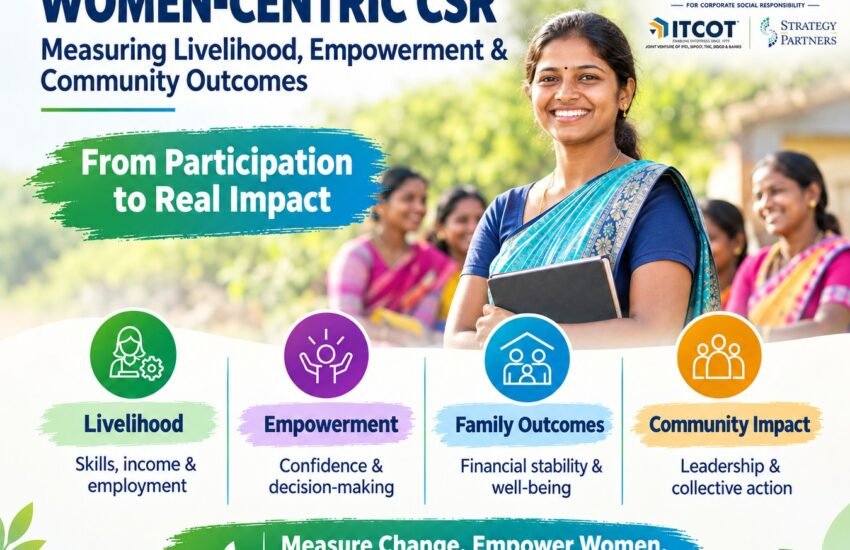
Corporate Social Responsibility (CSR) has increasingly moved beyond charitable contributions towards initiatives that create meaningful and sustainable change within communities. Social Impact Assessment plays an important role in understanding the effectiveness of CSR initiatives, especially women-centric programmes that focus on strengthening household resilience, improving livelihoods and supporting inclusive community development. However, the success of a women-focused CSR initiative cannot be assessed only by the number of women reached or the activities completed. The real question is whether these initiatives contribute to lasting improvements in women’s economic participation, decision-making, confidence, skills and overall well-being.
This is where Social Impact Assessment (SIA) becomes important. Social Impact Assessment helps organisations understand whether CSR initiatives are creating meaningful and measurable outcomes for women, their families and the wider community. SIAFORCSR provides an evidence-based approach to assess these changes and identify what is working, what needs improvement and whether the intended outcomes are being achieved. It helps organisations move beyond measuring activities and outputs to understanding the actual social impact taking place on the ground.
Moving Beyond Participation to Impact
Women-centric CSR programmes can support livelihood development, skill training, entrepreneurship, financial inclusion, healthcare, education and digital literacy. They can also support agriculture and women-led businesses.
Taking part in a programme is only the first step. Participation alone does not show real impact.
For example, a skill development programme may successfully train women in a particular activity. However, the long-term impact depends on whether the women are able to use those skills, access markets, generate income, gain employment or establish sustainable enterprises. Similarly, a financial literacy programme may provide knowledge, but its deeper impact can be understood by assessing whether women become more involved in household financial decisions or develop greater control over their earnings.
Therefore, impact assessment needs to examine the entire pathway from intervention to outcome.
Measuring Livelihood Outcomes
Livelihood improvement is one of the most important dimensions of women-centric CSR. Assessment should look beyond whether an individual received training or financial support and examine how the intervention influenced economic opportunities.
A comprehensive SIA can explore whether women have developed new sources of income, improved their existing occupations, gained access to employment opportunities or strengthened their entrepreneurial capabilities. It can also examine access to markets, financial services, technology, productive assets and institutional support.
The sustainability of livelihood outcomes is equally important. A temporary increase in income may not necessarily represent long-term impact. SIA can therefore assess whether women are able to continue their economic activities after project support reduces or ends.
Measuring Empowerment
Empowerment is broader than economic independence. It includes the ability of women to make decisions, express opinions, access resources and participate actively in matters affecting their lives and communities.
A women-centric CSR initiative may contribute to empowerment by creating opportunities for women to develop leadership skills, participate in community institutions and take greater responsibility for household or enterprise-related decisions.
Social Impact Assessment can capture these changes through beneficiary interviews, focus group discussions, stakeholder consultations and field observations. The assessment can explore whether women feel more confident, whether their voices are heard within households and community groups, and whether they have greater participation in decisions concerning education, health, finances, livelihoods and community development.
These qualitative changes can provide valuable insights that may not be visible through conventional CSR reporting.
Understanding Community-Level Outcomes
The impact of women-centric CSR extends beyond individual beneficiaries. When women gain economic opportunities, skills and decision-making capacity, the benefits can influence households and communities.
Improved livelihood opportunities may contribute to better household financial stability. Greater awareness of healthcare and education may influence family-level decisions. Women participating in community institutions may contribute to improved local planning and collective action.
SIA therefore considers the wider ecosystem in which the programme operates. It examines how changes experienced by women influence family members, peer groups, local institutions and the broader community.
Case Study: Women-Led Livelihood Transformation
Consider a CSR initiative implemented in a rural community with the objective of strengthening women’s livelihoods through skill development and enterprise support. The programme provides women with training, technical guidance, access to resources and support for connecting their products with local markets.
At the activity level, the programme appears successful. Women participate in training sessions, form groups and begin producing goods. However, an SIA is undertaken to understand whether the programme is creating sustainable change.
During the assessment, discussions with women reveal that the programme has helped them develop confidence in their ability to undertake economic activities. Several women report that they are now more comfortable interacting with customers, suppliers and local institutions. The group structure has also encouraged women to share knowledge, solve common problems and support each other.
The assessment further identifies changes within households. Women indicate that their contribution to household income has increased their participation in financial discussions. Some families have started consulting women on decisions related to household expenditure, children’s education and livelihood investments.
The impact is also visible at the community level. Women who initially participated only as beneficiaries have started taking leadership roles within their groups. They are increasingly involved in communicating with local institutions and coordinating community activities.
However, the assessment also identifies challenges. Market access remains inconsistent, some women require additional technical support and certain participants face difficulties in balancing enterprise activities with household responsibilities.
These findings provide the CSR organisation with a more complete understanding of the programme. Instead of reporting only that training was conducted or enterprises were supported, the organisation can identify what worked, where outcomes are emerging and where further intervention is required.
The case demonstrates an important principle: the success of women-centric CSR should be measured by the changes created in women’s lives, not simply by the activities delivered.
The Importance of Beneficiary Voices
One of the most valuable components of SIA is direct engagement with beneficiaries. Women may experience changes that are not captured in programme records or conventional CSR indicators.
For instance, a woman may not report a dramatic change in income but may describe increased confidence, greater mobility, improved knowledge or stronger participation in household decisions. Another beneficiary may highlight improved access to financial institutions or greater acceptance of women-led businesses within the community.
These perspectives help organisations understand the human dimension of CSR interventions.
Building Sustainable Women-Centric CSR
Sustainable impact requires continued attention to local needs and changing circumstances. CSR programmes should therefore be designed with participation from women and local stakeholders rather than relying solely on predetermined interventions.
SIA can support this process by identifying gaps, understanding beneficiary experiences and providing recommendations for programme improvement. Periodic assessments can help organisations determine whether outcomes are being sustained and whether the programme needs to be adapted.
The objective should be to create a cycle of assess, learn, improve and sustain.
Conclusion
Women-centric CSR has the potential to create impact that extends well beyond the individual beneficiary. When women gain sustainable livelihoods, confidence, skills and greater decision-making capacity, the resulting changes can influence families, institutions and communities.
However, meaningful impact cannot be understood through activity completion alone. Social Impact Assessment provides a structured approach to examine the depth, sustainability and wider effects of CSR initiatives.
For organisations committed to creating inclusive and sustainable development, the focus should shift from asking “How many women did the programme reach?” to asking “What changed in the lives of women, their families and their communities?”
SIAFORCSR can help organisations answer this question through evidence-based assessment, stakeholder engagement and a deeper understanding of outcomes. By placing women’s experiences at the centre of evaluation, CSR can move beyond implementation towards meaningful and lasting social impact.
