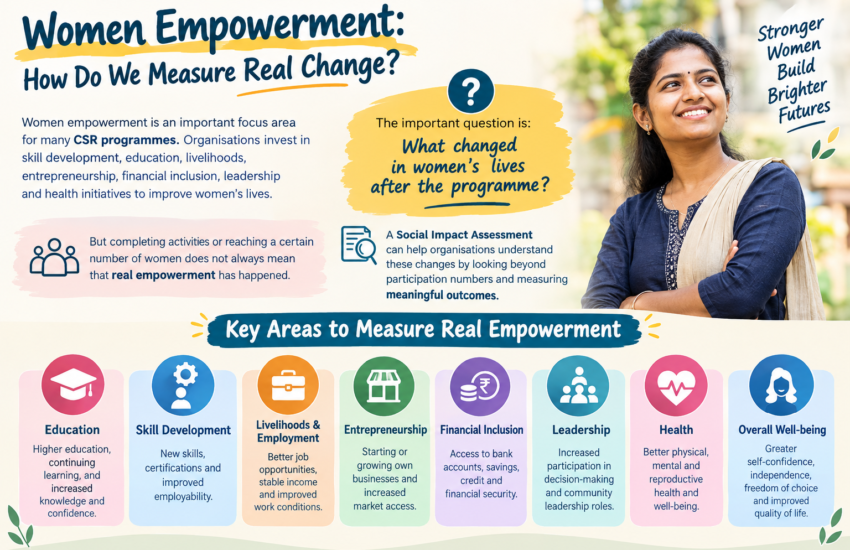
Women empowerment is an important focus area for many CSR programmes. Organisations invest in skill development, education, livelihoods, entrepreneurship, financial inclusion, leadership, and health initiatives to improve women’s lives. But completing activities or reaching a certain number of women does not always mean that real empowerment has happened. Social Impact Assessment helps organisations go beyond participation numbers and understand whether these CSR initiatives are creating meaningful and sustainable changes in women’s lives.
The important question is: What changed in women’s lives after the programme?
A Social Impact Assessment can help organisations understand these changes by looking beyond participation numbers and measuring meaningful outcomes.
Women Empowerment Is More Than Participation
A CSR programme may train 500 women, distribute equipment to 200 women, or provide financial support to 100 households. These numbers show what the programme delivered, but they do not fully explain its impact.
Real empowerment may be seen when women gain new skills, increase their income, participate in household decisions, become financially independent, or take leadership roles in their communities.
Therefore, measuring women empowerment requires looking at both what was done and what changed.
Measuring Changes in Skills and Knowledge
Training is often an important part of women-focused CSR programmes. However, attending a training programme does not automatically mean that women gained useful skills.
Assessment can examine:
Did women gain new knowledge or skills?
Are they using the skills after the programme?
Are the skills relevant to local employment or business opportunities?
Are women able to apply what they learned in their daily lives?
Did the training improve their confidence?
These indicators can help organisations understand whether training has moved beyond participation to actual outcomes.
Measuring Livelihood and Income Changes
Economic independence is an important part of empowerment.
A Social Impact Assessment can examine whether women experienced changes in:
Employment opportunities
Household income
Business income
Savings
Access to financial services
Ability to manage personal finances
Financial contribution to the household
For example, if a livelihood programme trained 300 women, the assessment should not stop at reporting the number trained. It can also ask how many women started working, started a business, increased their income, or continued using their skills after the programme.
Measuring Decision-Making and Confidence
Empowerment is not only about earning money. It can also involve greater participation in decisions that affect women and their families.
Assessment can explore whether women have greater involvement in decisions related to:
Household spending
Children’s education
Healthcare
Employment
Savings and investments
Starting or expanding a business
Community activities
Changes in confidence and communication can also provide useful insights into how women perceive their own ability to make decisions and take action.
Measuring Leadership and Community Participation
A successful women empowerment programme can create changes beyond individual women.
Women may begin participating more actively in:
Self-help groups
Community organisations
Local meetings
Awareness programmes
Collective decision-making
Community development activities
The assessment can look at whether women are moving from being programme participants to becoming active contributors and leaders within their communities.
Measuring Family-Level Outcomes
Changes in women’s lives can also influence their families.
Women’s increased income, knowledge, or decision-making power may contribute to changes in:
Children’s education
Household financial stability
Access to healthcare
Nutrition
Household savings
Overall family well-being
These outcomes help organisations understand the wider effects of women-focused CSR programmes.
Measuring Long-Term Change
One of the biggest challenges in women empowerment programmes is sustainability.
A programme may show positive results immediately after implementation, but what happens six months or one year later?
A Social Impact Assessment can help answer questions such as:
Are women still using the skills they received?
Are income improvements continuing?
Are businesses still operating?
Are women continuing to participate in community activities?
Have changes in decision-making continued?
What challenges are preventing further progress?
Long-term assessment provides a clearer picture of whether the programme has created sustainable change.
From Outputs to Outcomes
There is an important difference between outputs and outcomes.
Output: 500 women completed a skills training programme.
Outcome: 320 women started using the skills, 180 gained employment or income opportunities, and many reported greater confidence in making financial decisions.
The first statement tells us what the programme delivered. The second helps us understand what changed because of the programme.
This shift from activities to outcomes is essential for meaningful CSR impact measurement.
Why Community Voices Matter
Numbers alone cannot explain every change.
Women should have an opportunity to share their experiences, challenges, expectations, and suggestions. Interviews, focus group discussions, surveys, and community consultations can provide valuable insights into what worked and what did not.
Listening directly to women can help organisations identify barriers that may not appear in programme reports.
Using Social Impact Assessment to Measure Real Empowerment
A well-designed Social Impact Assessment can bring together quantitative data and qualitative experiences to understand the overall impact of a women empowerment programme.
It can help organisations measure:
Skills → Income → Decision-Making → Confidence → Leadership → Family Outcomes → Community Impact
This approach provides a broader understanding of empowerment instead of measuring success only through the number of beneficiaries reached.
Conclusion
Women empowerment should not be measured only by the number of women trained, supported, or enrolled in a programme. Real change is reflected in what women are able to do, how their lives have changed, and whether those changes continue over time.
For CSR organisations, the key question should be:
“After the programme ended, what changed in the lives of women and their communities?”
A Social Impact Assessment helps organisations answer this question with evidence, community insights, and measurable outcomes. By moving beyond participation and focusing on real change, CSR programmes can become more meaningful, responsive, and sustainable.
